Project
BeerGuard
About the Project
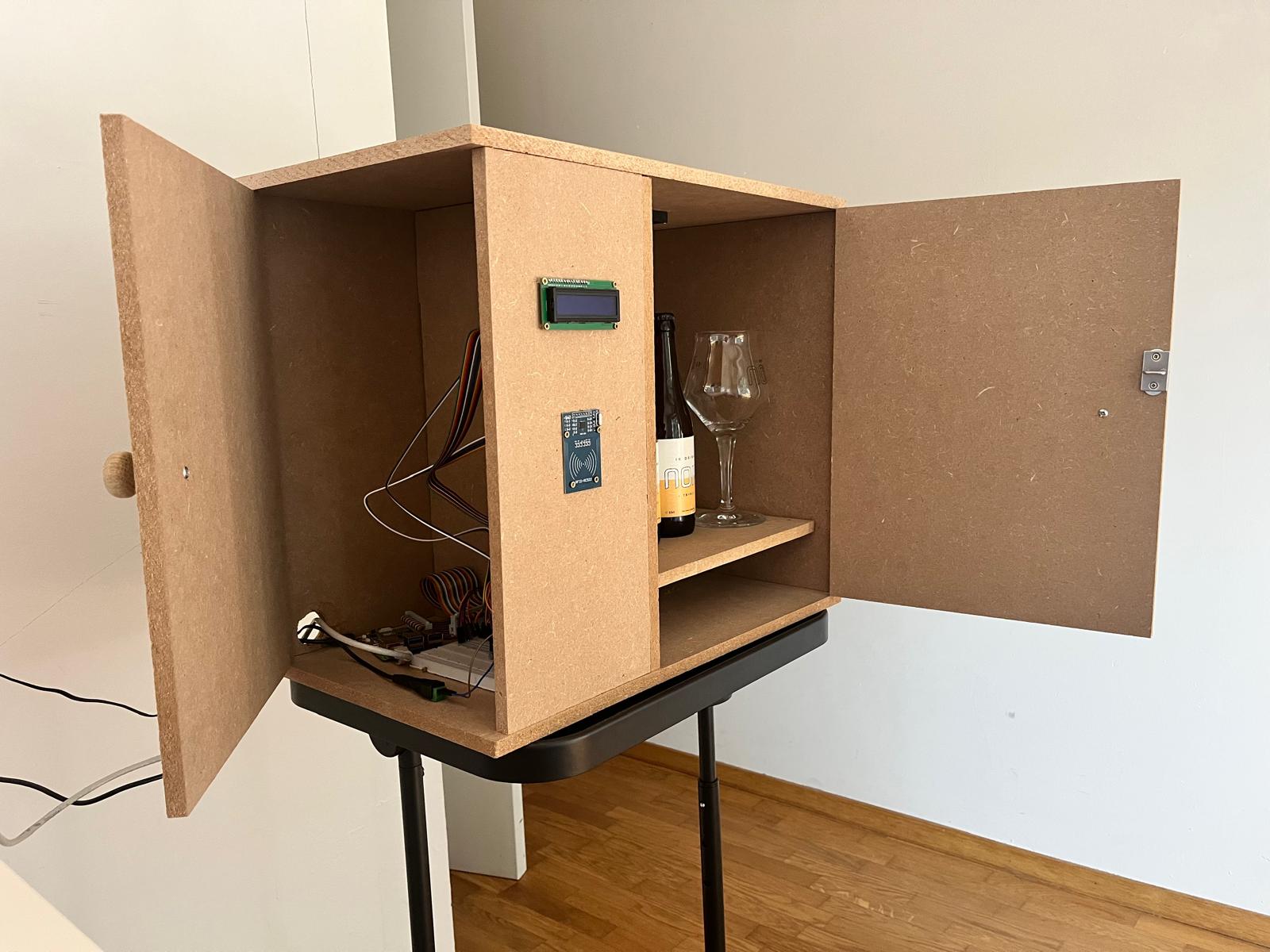
BeerGuard is an automated monitoring and inventory system, originally designed for "Nois Tripel," a beer I brew alongside my partner, Sem. The system guarantees product quality and optimizes inventory management. By providing constant monitoring, the system reduces spoilage and human error, leading to higher efficiency, lower costs, and consistent quality.
Core Features
- Climate Monitoring: The system continuously measures temperature, light intensity, and humidity to ensure optimal storage conditions, sending out warnings if any deviations occur.
- Smart Inventory System: The stock of bottles and glasses is accurately tracked using a high-precision weight sensor.
- Access Control: Users authenticate via an RFID badge. The system rejects unauthorized access and maintains a detailed log of who took which items and at what time.
- Responsive Web Dashboard: An online platform displays real-time sensor data, historical charts, inventory status, and system logs.
- Hardware Control (Actuators): The hardware can be managed directly through the website—for example, triggering a cooling fan when temperatures rise or performing a safe shutdown of the Raspberry Pi.
How I Built This (My Process)
I realized this project entirely on my own, from initial concept to finished product, within a timeframe of approximately three weeks. Here is my step-by-step approach:
Step 1: Preliminary Study & Design I began by creating a block diagram to map out the interactions between the Raspberry Pi, power supplies (including a 12V/2A supply), sensors, and actuators. Following this, I sketched the housing, designing two distinct compartments: a technical section for the electronics and a storage area for the beer.
Step 2: Hardware & Electronics Setup The heart of the installation is a Raspberry Pi. I interfaced it with a breadboard and implemented five different sensors:
- Temperature, humidity, and light sensors for climate control.
- A load cell (weight sensor) positioned under the storage platform to detect stock levels.
- An RFID reader linked to an electromagnetic door lock. I also integrated an LCD screen to display vital info (such as the IP address) and a fan to serve as the primary actuator.
Step 3: Fabrication & Assembly (Maker Skills) I constructed a miniature storage unit measuring 50 cm (L) x 30 cm (W) x 40 cm (H).
- Materials: The unit is built from wood (MDF/plywood), securely screwed together and reinforced with wood glue.
- Construction: The left compartment houses the electronics with its own access door. The right compartment is the main storage area, secured by a hinged door and the electric lock. I finished the housing with a clean coat of paint, engraved the "BeerGuard" branding, and added magnetic closures for a professional feel.
Step 4: Backend & Data Capture To process all incoming data, I set up a normalized SQL database running locally on the Raspberry Pi.
- The database stores structured data regarding products (glasses vs. bottles), actual storage conditions (with timestamps), users (badge IDs), and a comprehensive inventory log.
- I programmed custom logic to trigger alarms when environmental values exceed safety thresholds or when stock runs low.
Step 5: Frontend & Web Server Finally, I configured a web server on the Raspberry Pi to host a responsive web application. This frontend visualizes both real-time instantaneous data and historical trends, allowing for remote monitoring and control. Looking ahead, this data could be integrated into a platform to support online sales and automated restocking.